Indonesian Journal of Instructional Technology
https://journal.kurasinstitute.com/index.php/ijit
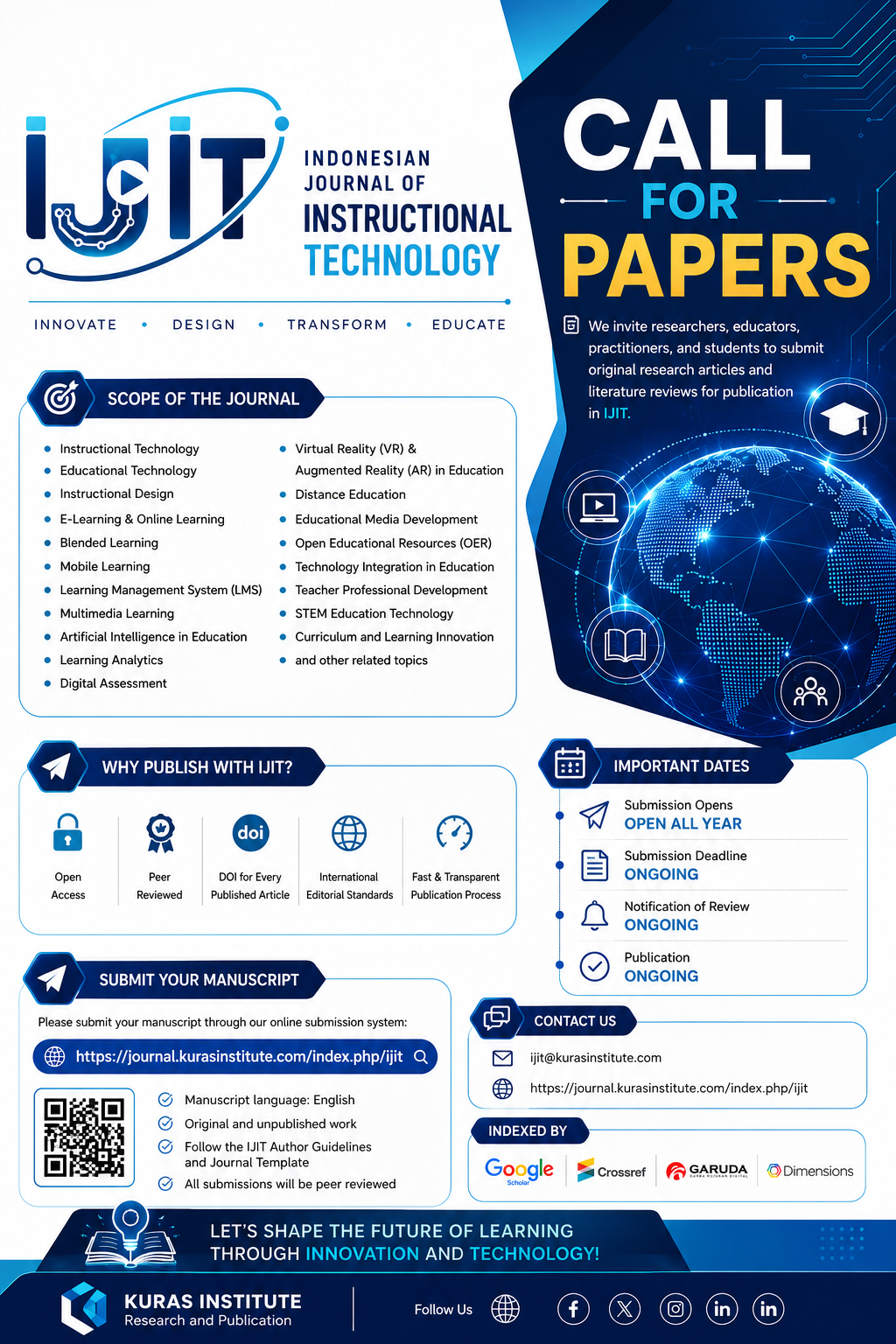
<p style="text-align: justify;">Indonesian Journal of Instructional Technology (IJIT) is a <span lang="en">scientific journal and open-access journal in the field of Instructional technology which contains conceptual studies and research results in the discipline of instructional technology. </span>The journal published twice a year (February and August) by the Kuras Institute in collaboration with Institut Agama Islam Ma'arif NU (IAIMNU) Metro Lampung. ISSN: 2721-8910 (Online). The scopes of the Indonesian Journal of Instructional Technology are the d<span lang="en">evelopment of instructional media/multimedia, problems and solutions in learning, d</span><span lang="en">evelopment of instructional designs (models, strategies, and methods) with technology and d</span><span lang="en">evelopment and use of e-learning in instructional.</span></p>Kuras Intitute in Collaboration With Institut Agama Islam Ma'arif NU (IAIM-NU) Metro Lampungen-USIndonesian Journal of Instructional TechnologyModel Project Based Learning Berbasis Video Digital untuk Mengembangkan Kreativitas dan Psikomotorik Ibadah Siswa MTs Pembangunan Kikil Arjosari Pacitan
https://journal.kurasinstitute.com/index.php/ijit/article/view/1817
<p>This study aims to describe the implementation of the Digital Video-Based Project Based Learning (PjBL) model in an effort to enhance creativity and worship psychomotor skills among students in Madrasah Tsanawiyah (MTs) Pembangunan Kikil Arjosari Pacitan. The primary issue in worship learning within madrasas is the dominance of conventional methods, leading to low student engagement. This research employs a descriptive qualitative approach, with data collection techniques including observation, interviews, and documentation. The results indicate that the digital video-based PjBL model provides students with the space to explore creativity in presenting dawah content while improving the accuracy of worship movements (psychomotor) through a video production process that requires conscious repetition. The project stages encompassing scenario planning, filming, and video reflection are highly effective in forming students' muscle memory regarding worship procedures in accordance with Fiqh principles.</p>Ririn Afidatul MunirohYuli Ani Setyo Dewi
Copyright (c) 2026 Indonesian Journal of Instructional Technology
2026-02-122026-02-127110.49056/ijit.v7i1.1817